ЛЕКЦИЯ № 37. Oral glands
ЛЕКЦИЯ № 37. Oral glands
All mammals are well supplied with oral glands. There are numerous small glands, such as the labial glands of the lips, buccal glands of the cheeks, lingual glands of the tongue, and palatine glands of the palate. Besides these, there are larger paired sets in mammals that are quite constant from species to species and are commonly designated as salivary glands. The parotid gland, near each ear, discharges into the vestibule. The submaxillary or submandibular gland lies along the posterior part of the lower jaw; its duct opens well forward under the tongue. The sublingual gland lies in the floor of the mouth. It is really a group of glands, each with its duct. Saliva is a viscid fluid containing a mixture of all the oral secretions. It contains mucus, proteins, salts, and the enzymes ptyalin and maltase. Most of the ptyalin in human saliva is furnished by the parotid gland. The digestive action of saliva is limited to starchy food. Other uses of saliva include the moistening of food for easier manipulation by the tongue, the consequent facilitation of swallowing, and a lubrication by mucus that ensures a smoother passage of food down the esophagus to the stomach. The daily amount of saliva produced by an adult is about 1,5 quarts. Tonsils are spongy lymphoid tissues at the back of the throat, composed mainly of lymphocytic cells held together by fibrous connective tissue. There are three types of tonsils. The palatine tonsils, usually referred to as «the tonsils», are visible between the arches that extend from the uvula to the floor of the mouth. The pharyngeal tonsils, usually referred to as the adenoids, lie at the back of the throat. The lingual tonsils are on the upper surface of each side of the back of the tongue. The tonsils function to protect the pharynx and the remainder of the body from infectious organisms that become trapped in the mucous membrane lining the mouth, nose and throat. Chronic or acute inflammation of the tonsils, called the tonsillitis, may serve as a source of infection elsewhere in the body.
Tongue
The tongue, a muscular organ in the mouth, provides the sense of taste and assists in chewing, swallowing, and speaking. It is firmly anchored by connective tissues to the front and side walls of the pharynx, or throat, and to the hyoid bone in the neck.
The mammalian tongue is divided into two parts by a V-shaped groove, the terminal sulcus. At the apex of this V is a small blind pit, the foramen cecum. The larger part, or body, of the tongue belongs to the floor of the mouth, whereas the root forms the front wall of the oral pharynx. The body of the tongue is separated from the teeth and gums by a deep groove. A midline fold, the frenulum, is near he tip on the undersurface. The upper surface of the body, called the dorsum, has a velvety appearance because of filiform papillae. Distributed among these are occasional larger, rounded fungiform papillae and some large conical papillae. Immediately in front of the groove separating the body of the tongue from the root is a series of still larger vallate papillae arranged in a V-shaped row. The apex of the V points down the throat. Posteriorly along each side of the body of the tongue and near the root, is a series of parallel folds constituting the foliate papillae. The surface of the root of the tongue, which belongs to the pharynx, has no papillae but bears nodules containing lymphoid tissue.
New words
mammals – млекопитающие
supplied – поставляемый
glands – железы
numerous – многочисленный
labial – губной
buccal – относящийся ко рту или щеке
lingual – языковой
palatine – небный
paired sets – соединенные ячейки
designated – определяемый
salivary glands – слюнные железы
parotid – околоушная железа
gland – железа
discharges – увольнения
vestibule – преддверие
submaxillary – верхнечелюстной
submandibular – нижнечелюстный
lie – ложь
along – вперед
sublingual – подязыковой
Present Continuous Tense (действие происходит в процессе, совершается в тот момент, когда о нем говорят) = (now, at the moment)
Спряжение глагола to work в Present Continuous Tense Таблица 8
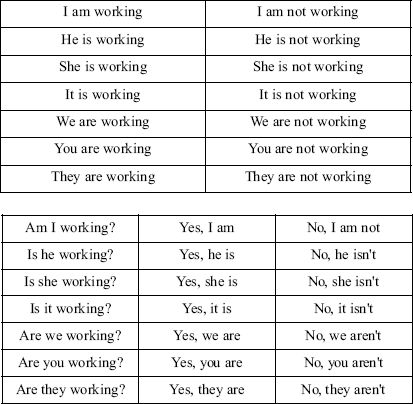
Раскройте скобки, употребляя глаголы в Present Continuous.
(NOW)
1. The boys (to run) about in the garden.
2. I (to do) my homework.
3. John and his friends (to go) to the library.
4. Ann (to sit) at her desk. She (to study) geography.
5. A young man (to stand) at the window. He (to smoke) a cigarette.
6. The old man (to walk) about the room,
7. The dog (to lie) on the floor.
8. You (to have) a break?
9. What language you (to study)?
10. Who (to lie) on the sofa?
Переведити на английский язык.
1. Я читаю.
2. Он не пишет.
3. Мы не работаем.
4. Вы читаете?
5. Он спит?
6. Коля и Миша играют в футбол.
7. Катя играет на рояле.
8. Она не поет.
9. Моя сестра спит.
10. Папа пьет чай?
Answer the questions.
1. Are all mammals well supplied with oral glands?
2. Enumerate small glands?
3. Where are the parotid gland situated?
4. Where is submaxillary located?
5. What is saliva?
6. What limits the digestive action of saliva?
7. How much is the daily amount of saliva?
8. How is the mammalian tongue divided?
9. What provides the sense of taste?
10. From what the body of the tongue is separated?
Make the sentences of your own using the new words (10 sentences). Find the verb to be in the text. Explain why it is used in such a way?
Более 800 000 книг и аудиокниг! 📚
Получи 2 месяца Литрес Подписки в подарок и наслаждайся неограниченным чтением
ПОЛУЧИТЬ ПОДАРОКЧитайте также
26-я ЛЕКЦИЯ
26-я ЛЕКЦИЯ Cucurbitaceae — Тыквенные Cucurbitaceae:1. Colocyinths cucumis.2. Bryonia alba3. Citrullus. Семена мочегонны.4. Cucurbita (скваш-s quash тыква).5. Momordica balsamum. Ветры.6. Flaterium momordica. Кишки и лихорадка.Сегодня мы начнем изучение Cucurbitaceae. Это семейство дает нам около шести или восьми лекарств, а также несколько
28-я ЛЕКЦИЯ
28-я ЛЕКЦИЯ Coniferae и Euphorbiaceae Coniferae — Хвойные Pinus sylvestris. Детская атрофия. Abies nigra. Желудок. Sabina Juniperus. Выкидыш.Terebenthina.1. Почки, мочевой пузырь и пр.2. Слизистые оболочки.3. Матка.4. Тифозные состояния.5. Почечная водянка.Сравните — Arsenicum, Cantharis, Copaiva, Camphora, Phosphorus.Pix liquida. Легкие
29-я ЛЕКЦИЯ
29-я ЛЕКЦИЯ Ranunculaceae — Лютиковые Aconitum.Helleborus niger.Paeonia.Pulsatilla.Hydrastis.Staphisagria.Actea racemosa.Actea spicata.Radix coptidis.Ranunculus
33-я ЛЕКЦИЯ
33-я ЛЕКЦИЯ Rubiaceae — Мареновые Rubiaceae:1. Rubia titctoiria (Марена).2. Galium (Тоже красная краска).3. Cinchona.4. Ipecacuanha.5. Coffea.6. Mitchella.7. Gambier.Сегодня перед нами семейство растений, из которого мы получаем три очень ценных средства, Cinchona, Ipecacuanha и Coffea. Это семейство дает нам также Gambier (Gambogia,
35-я ЛЕКЦИЯ
35-я ЛЕКЦИЯ Scrophulariaceae — Норичниковые China. Из этого семейства растений мы получаем Digitalis, Gratiola, Leptandra viginica, Euphrasia, Verbascum и Linaria. У нас имеется немного симптомов для каждого из этих средств, и те, которые известны, достаточно определенны, чтобы их легко запомнить. Важнейшим
37-я ЛЕКЦИЯ
37-я ЛЕКЦИЯ Solanaceae — Пасленовые Solanaceae:1. Belladonna.2. Hyoscyamus.3. Stramonium.4. Solan um nigr.5. Tabacum.6. Dulcamara.7. Capsicum.Средства, образующие эту группу по своей симптоматологии очень сходны друг с другом. Едва ли найдется хоть один симптом у этих средств, который не встречался бы почти в том же виде
42-я ЛЕКЦИЯ
42-я ЛЕКЦИЯ Минеральная группа В прилагаемой таблице я разместил для вашего изучения элементы по их взаимному соотношению до некоторой степени так же, как мы находим это в химии. Поэтому они не расположены в порядке, принятом в фармакологии. Но ведь это не абсолютный
63-я ЛЕКЦИЯ
63-я ЛЕКЦИЯ Соли извести (Calcarea) Существует целый ряд солей извести, более или менее хорошо исследованных. Первая на этой таблице стоит Calcarea ostrearum или устричная известь. Этот препарат, данный нам Ганеманом, был испытан в качестве углекислой соли извести, Calcarea carbonica. Его
65-я ЛЕКЦИЯ
65-я ЛЕКЦИЯ Препараты натрия Препараты Соды (Натрия) в химическом и медицинском отношении совершенно сходны с препаратами Поташа (Калия), но это сходство не таково, чтобы они не могли быть назначаемы вслед за солями Калия. Мы увидим, что Kali carb. служит дополнением для Natrum mur. в
68-я ЛЕКЦИЯ
68-я ЛЕКЦИЯ Соли Калия Токсикологически калий может представлять для вас некоторый интерес, когда кто-либо случайно проглотит едкое кали. Большое сродство этого вещества к воде заставляет его жадно отнимать воду от тканей и в результате получается глубокий ожег
41. Oral cavity
41. Oral cavity The oral cavity forms in the embryo from an in—pocketing of the skin, stomodeum; it is, thus, lined by ectoderm. Functionally, the mouth forms the first portion of both the digestive and respiratory systems.In humans the margins of the lips mark the junction between the outer skin and the inner mucous lining of the oral cavity. The roof of the mouth consists of the hard palate and, behind this, the soft palate which merges into the oropharynx. The lateral walls consist of
42. Oral glands
42. Oral glands All mammals are well supplied with oral glands. There are labial glands of the lips, buccal glands of the cheeks, lingual glands of the tongue, and palatine glands of the palate. Besides these, there are larger paired salivary glands. The parotid gland, near each ear, discharges into the vestibule. The submaxillary or submandibular gland lies along the posterior part of the lower jaw; its duct opens well forward under the tongue. The sublingual gland lies in the floor of the
ЛЕКЦИЯ № 1. Вводная лекция. Медицинская символика различных времен и народов
ЛЕКЦИЯ № 1. Вводная лекция. Медицинская символика различных времен и народов История медицины – это наука о развитии, совершенствовании медицинских знаний, медицинской деятельности разных народов мира на протяжении всей истории человечества, которая находится в
ЛЕКЦИЯ № 36. Oral cavity
ЛЕКЦИЯ № 36. Oral cavity The oral cavity forms in the embryo from an in-pocketing of the skin, stomodeum; it is, thus, lined by ectoderm. Functionally, the mouth forms the first portion of both the digestive and respiratory systems. Various special structures are found in, or associated with, the mouth.In humans the margins of the lips mark the junction between the outer skin and the inner mucous lining of the oral cavity. The roof of the mouth consists of the hard palate and, behind
Лекция 1
Лекция 1 Еще раз здравствуйте, уважаемые соратники.Начинаем наше первое занятие в Народном университете здорового образа жизни по методу Геннадия Андреевича Шичко. Курс будет посвящен коррекции зрения по методу Шичко-Бейтса. Это курс общего оздоровления и избавления от
Лекция 2
Лекция 2 Итак, здравствуйте, уважаемые соратники.Начинаем наше второе занятие в Народном университете здорового образа жизни по методу Геннадия Андреевича Шичко. Курс посвящен коррекции зрения по методу Шичко-Бейтса. Это курс общего оздоровления и избавления от вредных